
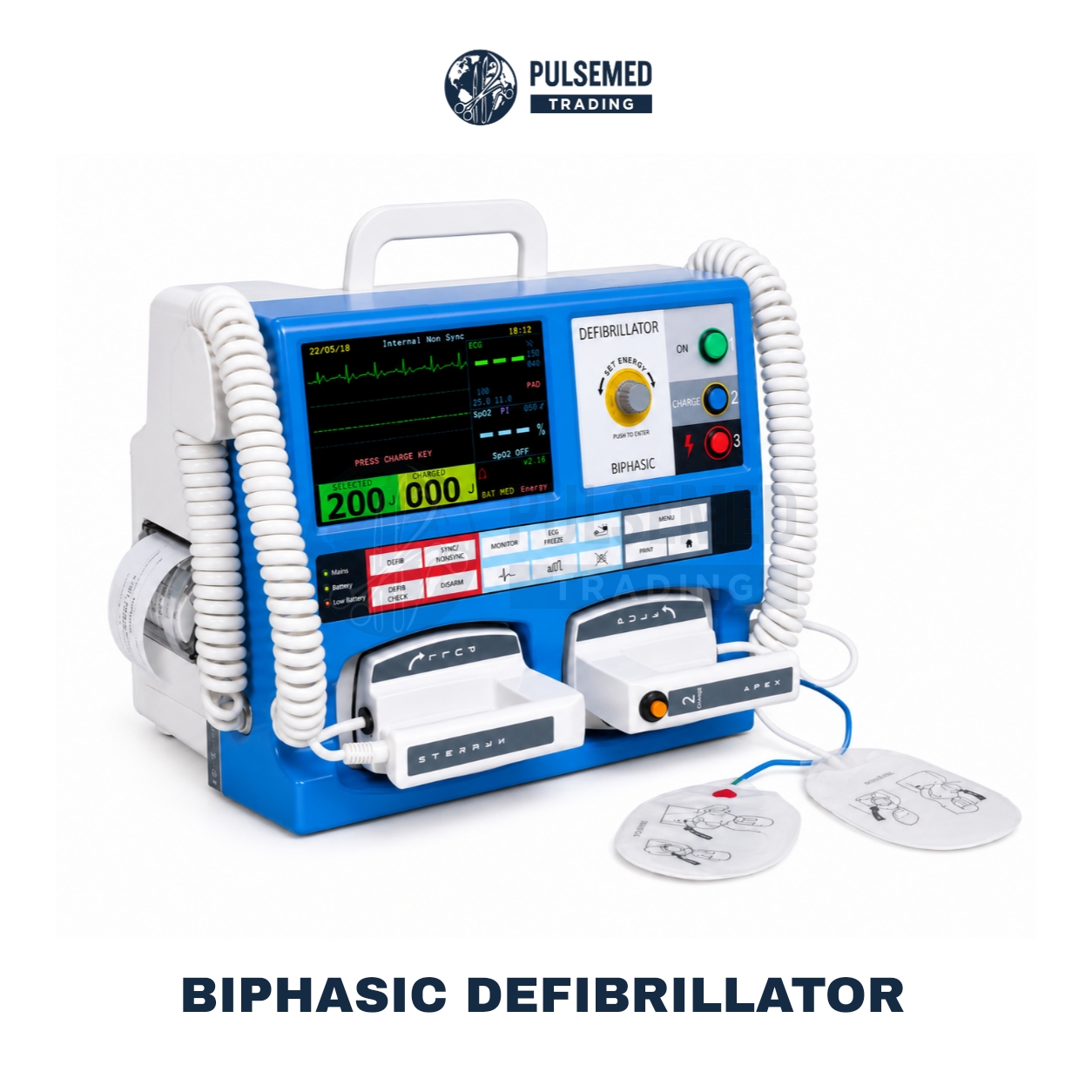
Widely used in hospitals, emergency departments, ambulances, intensive care units (ICUs), operating rooms, cardiac care units (CCUs), clinics, and public emergency response systems, biphasic defibrillators are considered the modern standard for cardiac resuscitation.
How a Biphasic Defibrillator Works
When a patient experiences sudden cardiac arrest, the heart’s normal electrical activity becomes chaotic, preventing it from pumping blood effectively. A biphasic defibrillator delivers a carefully controlled electrical shock that briefly stops the abnormal electrical activity, allowing the heart’s natural pacemaker to restore a normal rhythm.
Unlike traditional monophasic defibrillators, biphasic technology reverses the direction of the electrical current during the shock, increasing effectiveness while using less energy.
Key Features
- Advanced biphasic waveform technology
- High first-shock success rate
- Lower energy delivery with reduced myocardial stress
- Manual and AED operating modes (model dependent)
- Built-in ECG monitoring
- Large high-resolution color display
- Synchronized cardioversion capability
- Continuous patient monitoring
- Rechargeable long-life battery
- Lightweight, portable, and durable design
- Internal memory for patient event storage
- Voice and visual prompts for easy operation
- Quick charging for emergency readiness
Benefits
- Higher defibrillation success with lower energy
- Minimizes heart muscle injury
- Faster response during emergencies
- Easy operation for healthcare professionals
- Reliable performance in critical situations
- Suitable for adult and pediatric patients (with appropriate accessories)
- Improves survival rates during sudden cardiac arrest
- Compact design for easy transportation
Applications
Biphasic Defibrillators are commonly used in:
- Hospitals
- Emergency Rooms (ER)
- Intensive Care Units (ICU)
- Cardiac Care Units (CCU)
- Operation Theatres (OT)
- Ambulances
- Emergency Medical Services (EMS)
- Clinics and Diagnostic Centers
- Nursing Homes
- Medical Colleges and Training Institutes
- Public Access Defibrillation Programs
- Industrial and Corporate Medical Facilities
Why Choose a Biphasic Defibrillator?
Modern biphasic technology offers superior clinical performance compared to older monophasic systems. Lower energy requirements, faster recovery, improved patient safety, and reliable operation make biphasic defibrillators the preferred choice for healthcare providers worldwide. Their user-friendly interface, advanced monitoring capabilities, and robust construction ensure dependable performance in both hospital and pre-hospital emergency care.

Reviews
There are no reviews yet.